
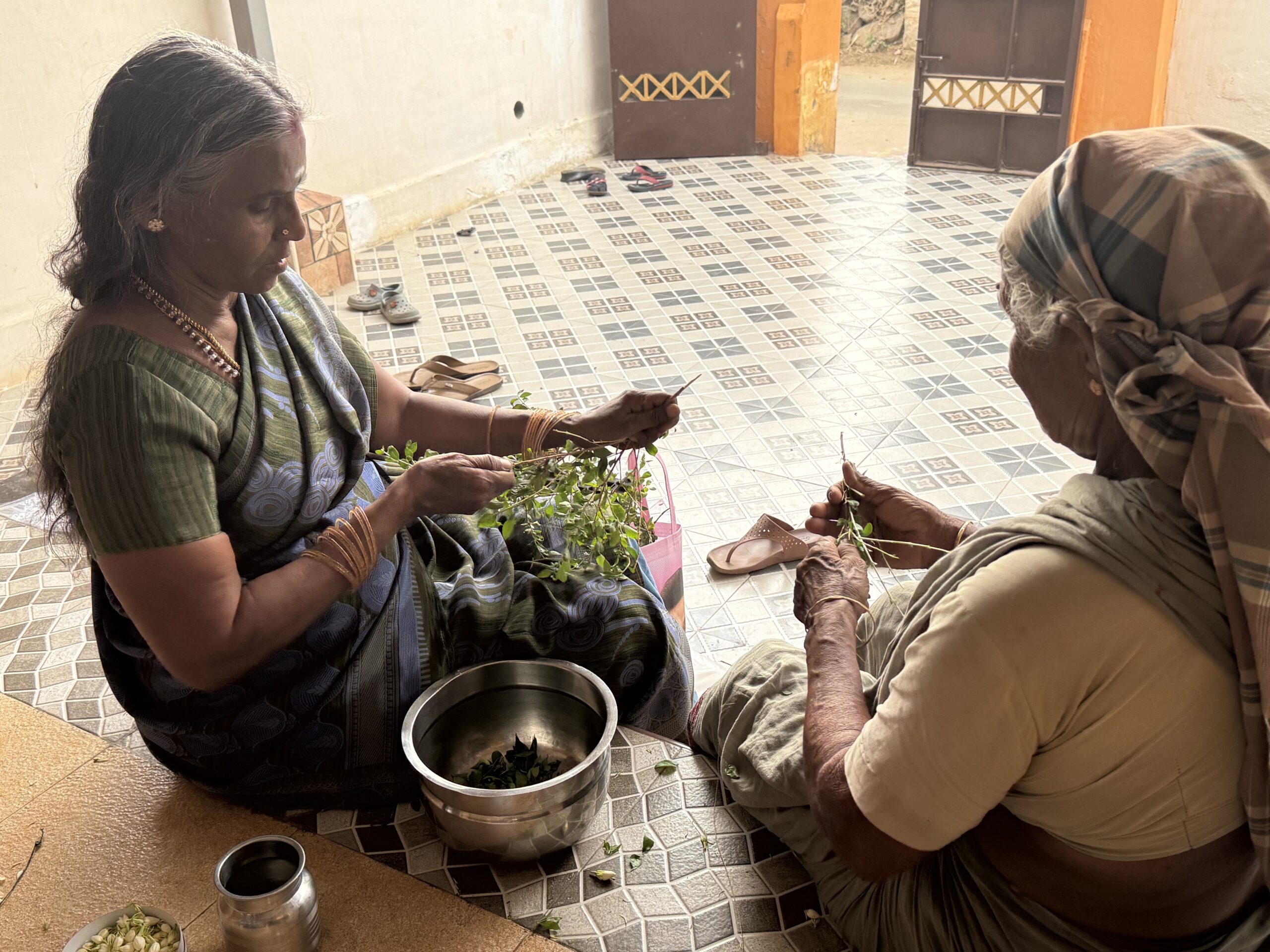
I took this photograph during my recent family vacation in South India at my in-laws’ village property. I was sitting quietly in the corner, observing what seemed like an ordinary moment.
The woman on the left is my mother-in-law. She had gathered fresh leaves and begun the deliberate and care-full process of picking and preparing them for mehndi, which would be used to decorate the hands for a family function. The process of picking leaves was not an event. It was simply part of the rhythm of the day, familiar, unremarkable, almost invisible in its routine.
As I watched, a neighbor walked in.
She did not ask what was happening. She did not ask if help was needed. She did not announce her presence in the activity. She simply sat down beside her and began picking the leaves too. No one acknowledged the participation. No one named it. No one paused to define roles or intentions.
And yet, everything changed.
What began as an individual task became a shared one- without instructions, without negotiation, without recognition. The neighbor did not leave after a few minutes. She stayed. The work continued, dialogically, collectively, until it was completed. There was something deeply compelling about this moment. Not because it was extraordinary, but because it revealed something we often overlook.
When we talk about volunteering for impact, we often imagine it as structured actions, such as organized initiatives, defined roles, measurable outcomes, and visible contributions. Impact is something we plan, design, and evaluate. But what I witnessed that day made me pause.
Because there was no plan.
No defined role.
No measurement of contribution.
And yet, something meaningful happened. My latest blog series begins from that tension. I ask a simple but crucial question: What if some of the most impactful forms of volunteering are the ones we do not recognize as volunteering at all?
The moment I observed did not follow the normative script of ‘helping’, and still, there was a strong sense of care. There was contribution, and there was completion. This challenges the way we often think about volunteering, especially in institutional and organizational contexts where help is requested or assigned, contributions are tracked, and impact is measured. But everyday life often tells a different story. There are forms of participation that are intuitive rather than instructed, relational rather than transactional, and continuous rather than time-bound.
Such forms rarely appear in reports or frameworks. They do not come with metrics. They do not seek recognition, and yet, they sustain the very fabric of communities. This series is not about dismissing structured volunteering or measurable impact, as those matter a lot. However, it is about widening the lens through which we decide to look. It is about beginning from moments like the one I observed, where someone notices without being told, someone joins without being asked, or someone stays without counting time. Moments that are easy to overlook precisely because they are quite ordinary but carry within them a different understanding of what it means to contribute, to care, and to be present with others.
The above image is not just a photograph. It is a starting point and a reminder that impact does not always begin with intention, structure, or visibility. Sometimes it begins simply with:
With someone noticing.
With someone joining.
With someone staying.
And possibly, by paying attention to these moments, we begin to see that volunteering for impact is not only something we design, but also something we often live without naming at all.